Applications of Agentic AI: 5 Industries Being Transformed in 2026
 YenDH
YenDH
Generative AI gets all the headlines, but applications of Agentic AI are quietly reshaping how entire industries operate. Unlike chatbots that just answer questions, Agentic AI systems take action, making decisions, orchestrating workflows, and executing complex tasks with minimal human supervision. The difference is profound: generative AI might draft an email; Agentic AI sends it, monitors replies, and schedules follow-ups based on outcomes.
But here’s the challenge facing business leaders today: understanding which AI agent use cases deliver real ROI and which are just vendor hype isn’t always straightforward. According to Google Cloud’s 2025 ROI of AI Report, 74% of executives report achieving ROI within the first year of deploying AI agents. Yet many organizations still struggle to identify where agentic AI delivers the most value. This article cuts through the noise, presenting five industry-specific applications already proven in production environments worldwide.
What Makes Applications of Agentic AI Valuable in Real Use Cases?
Most AI tools deployed in businesses today are reactive. You give them a prompt, they return an answer, and they stop. A standard LLM chatbot cannot take action in the world, remember what happened yesterday, or retry when something goes wrong. That is where agentic AI is fundamentally different.
An agentic AI system is designed to pursue a goal over time with minimal human instruction. It can break a high-level objective into steps, call the right tools at each step (APIs, databases, web browsers, code executors), remember context across a long workflow, and self-correct if a step fails. This is what makes real-world agentic AI applications so powerful: they do not just answer questions – they complete entire workflows autonomously.
The three properties that unlock real-world value:
- Autonomy over time: an agentic AI can run for hours or days on a multi-step task – no human needed at every step
- Tool use: agents can interact with real systems – send emails, query databases, run code, fill forms, generate reports
- Self-correction: when a step fails, the agent tries again with a different approach rather than stopping and asking for help
=> This capability is driving unprecedented adoption. According to industry data, 57% of companies already have AI agents in production, with 70% saying agents are “core to operations.” Organizations have seen 40% cost savings and 23% faster workflows, with one in three reporting speed gains of over 50% in marketing and sales functions.
The market trajectory reinforces this momentum. Gartner projects that 40% of enterprise applications will feature task-specific AI agents by the end of 2026, up from less than 5% in 2025.
💡 Key Insight: Investment in agentic AI is projected to reach $139.19 billion by 2034, growing at a CAGR of 40.5%. The question is no longer if your industry will adopt agentic AI-but which applications you should prioritise first.
Industry Use Cases – How 5 Sectors Are Deploying AI Agents in Production
Each industry below has distinct drivers, constraints, and starting points for agentic AI adoption. What they share is a common pattern: the applications that succeed start with well-defined, high-volume, repeatable workflows – and prove value quickly before expanding.
1. Finance – Speed, Accuracy, and Compliance at Scale
Financial services is one of the fastest-moving sectors for agentic AI adoption, driven by the combination of high transaction volumes, strict regulatory requirements, and massive penalties for errors. The industry is projected to invest $97 billion in AI by 2027, according to a World Economic Forum and Accenture joint report.
Use Case 1 – Fraud Detection Agent
A fraud detection agent monitors transactions in real time, cross-referencing behavioral patterns, device fingerprints, geolocation data, and historical baselines simultaneously. When a transaction deviates from established patterns, the agent flags it, investigates supporting data, and either blocks the transaction or escalates with a documented rationale – all within milliseconds.
Real result: 19% of Fortune 500 companies achieved full automation of financial reconciliation tasks in 2025 using agentic AI – eliminating nearly all manual interventions.
Use Case 2 – Risk Analysis Pipeline
Multi-agent risk analysis systems assign specialized sub-agents to ingest market data, run statistical models, cross-check regulatory requirements, and produce risk reports – in parallel. What previously took a team of analysts several days can be completed in hours, with higher consistency and full audit trail compliance.
McKinsey Q1 2025: 45% of Fortune 500 firms are running pilots with automated investment research agents in finance.
Use Case 3 – Compliance and KYC Automation
Document agents process Know Your Customer (KYC) submissions by reading ID documents, cross-referencing public databases, flagging discrepancies, and producing a compliance summary with a risk score – handling in minutes what previously required a compliance officer several hours.
2. Healthcare – Reducing Admin Burden, Improving Patient Outcomes
Healthcare leads all industries in agentic AI adoption rate, with 68% of organizations already using AI agents in some capacity. The primary driver is not cost – it is time. Clinical staff spend an estimated 30-40% of their working hours on administrative tasks. Agentic AI is attacking that problem directly. (Source: KPMG).
Use Case 1 – Clinical Documentation Agent
Clinical AI agents listen to doctor-patient conversations (with consent), generate structured clinical notes, populate the EHR system, and flag any missing information for physician review. The physician reviews and approves rather than writes – fundamentally shifting the task from creation to validation.
AtlantiCare (New Jersey): 42% reduction in documentation time across 50 providers – saving approximately 66 minutes per day per provider. Adoption rate: 80%.
Use Case 2 – Patient Data Processing
Patient intake agents collect medical history, insurance information, and symptom data before an appointment – verifying information against existing records, flagging inconsistencies, and pre-populating clinical workflows. This removes one of the most time-consuming pre-appointment tasks from clinical staff entirely.
Healthcare CAGR for AI agent adoption: 48.40% (2025-2034) -the fastest-growing segment in the agentic AI market.
3. E-Commerce – Faster Support, Smarter Operations
Customer service is the largest single application of agentic AI globally, holding a 32.2% market share in 2025. E-commerce is the clearest beneficiary, because the combination of high ticket volumes, predictable customer intents, and direct linkage to revenue makes the ROI straightforward to measure and prove.
Use Case 1 – Customer Support Automation Agent
A customer support agent handles the full lifecycle of a support interaction: reads the customer message, retrieves order history, checks inventory or shipping status, applies return or refund policy, generates a response, and – if the resolution requires action – executes it (processes refund, updates shipping address, cancels order). No human involved until a genuinely complex edge case requires escalation.
By 2028, agentic AI is projected to manage 68% of all customer service interactions with technology vendors (Cisco).
Use Case 2 – Order Handling and Returns Automation
Order lifecycle agents monitor shipments, proactively notify customers of delays, process return requests against policy rules, initiate refunds, and update inventory – creating a closed-loop post-purchase experience that requires no human touchpoint for standard cases.
Use Case 3 – Real-Time Personalization Agent
Personalization agents analyze browsing behavior, cart contents, and purchase history at query time to surface the most relevant product recommendations – not from a pre-computed batch, but in real time based on what the customer is doing right now.
4. SaaS / Tech – AI Building AI
The software industry is both the most sophisticated adopter and the most direct beneficiary of agentic AI. Engineering teams at SaaS companies are using AI agents to accelerate their own development workflows – creating a compounding advantage: better AI tools, built faster, by AI-augmented teams.
Use Case 1 – AI Development Assistant (Coding Agent)
The impact of agentic AI on database operations alone is striking. Databricks reports that AI agents now create 80% of databases, up from near zero just two years ago. Furthermore, 97% of database testing and development environments are now built by AI agents, dramatically reducing the time needed to clone, branch, and test databases.
With the rise of ‘vibe coding’, business users without deep technical expertise can create AI applications, democratising technology across companies. Over 50,000 data and AI applications have been created, with a 250% growth rate over six months
Use Case 2 – QA Automation Agent
BrowserStack launched a suite of five AI agents purpose-built for software testing:
- Test Case Generator – Reduces test creation time by over 90% while improving coverage. The agent analyses Product Requirements Documents and user stories to generate comprehensive, context-aware test cases, identifying edge cases and validating business logic.
- Low-Code Authoring Agent – Converts test cases into reliable automated tests up to 10× faster.
Katalon AI Assistant provides access to six specialised QA agents. The Root Cause Analyzer classifies failures as script issues, application bugs, or environment problems. The Production Monitor Agent correlates test failures and defects with real user impact in production, including pre- and post-deploy comparisons. The Report and Insight Agent answers plain-language questions about coverage, defects, and release readiness, including GO/NO-GO recommendations.
Open-source projects are also advancing rapidly. QA Panda lives inside VSCode, launching a headless Chrome browser that gives AI agents full control-they can navigate pages, fill forms, click buttons, inspect the DOM, monitor network requests, and read console output.
Use Case 3 – Emerging Multi-Agent QA Frameworks
Agentic QE Fleet is an open-source AI-powered QA platform featuring specialised agents and skills to support testing activities at any stage of the software development lifecycle. Its capabilities include generating tests, finding coverage gaps, detecting flaky tests, and learning codebase patterns across 11 coding agent platforms.
🔧 Recommended Framework: According to adoption data, multi-agent systems outperform single-agent systems by 90.2% on complex tasks, making them the preferred architecture for sophisticated QA workflows. However, start with a single-agent approach if you’re new to AI in testing-it’s easier to debug and audit.
5. Manufacturing – Real-Time Decisions in Complex Environments
Manufacturing is the fastest-growing end-use segment for AI agents, with a projected CAGR of 49.2% from 2026 to 2033. The appeal is direct: manufacturing operations generate enormous volumes of sensor, quality, and logistics data – and the cost of poor decisions (downtime, defects, delays) is immediately measurable.
Use Case 1 – Predictive Maintenance Agent
Maintenance agents continuously monitor sensor data from machinery – vibration, temperature, pressure, cycle counts – and predict failure windows before equipment breaks down. When a failure signature is detected, the agent schedules maintenance, orders parts, and notifies the relevant engineer – all before the line stops.
In May 2025, Siemens rolled out advanced AI agents integrated with its Industrial Copilot ecosystem – capable of managing entire industrial workflows without human oversight.
Use Case 2 – Operations and Supply Chain Optimization
Multi-agent supply chain systems monitor inventory levels, supplier lead times, demand forecasts, and logistics bottlenecks simultaneously – and autonomously adjust procurement orders, reroute shipments, or update production schedules when conditions change.
77% of manufacturers now use AI in some form, up from 70% in 2025. Industrial AI agents are expected to grow at 49.2% CAGR through 2033. (Source: Salesmate)
Use Case 3 – Quality Control Agent
Vision-enabled quality agents inspect products on the production line using computer vision and anomaly detection – flagging defects in real time, correlating defect patterns with upstream process variables, and recommending adjustments to prevent recurrence.
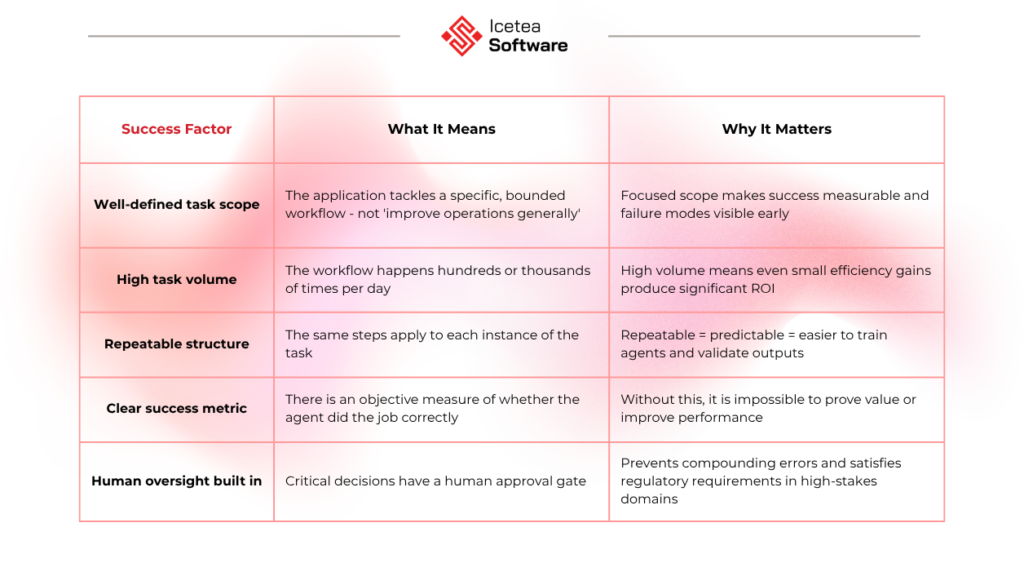
The Common Thread: What These Applications Have in Common
Looking across these five industries, the agentic AI applications that are working in production share a set of common characteristics. Understanding these patterns is essential for any organization deciding where to start its own deployment.
Where agentic AI applications struggle (and why)
• Poorly defined goals: ‘use AI to improve customer experience’ is not actionable – ‘reduce support ticket resolution time by 30%’ is
• Low-volume, high-variety tasks: if every instance of a workflow is completely unique, agents cannot generalize effectively
• Insufficient data: agents need historical examples of correct behavior to learn from and be evaluated against
• No human oversight layer: in regulated industries especially, fully autonomous agents without review points create compliance and reputational risk
• Gartner warning: over 40% of agentic AI projects will be cancelled by end of 2027 – most due to unclear ROI and inadequate risk controls
How to Identify the Right Agentic AI Application for Your Business
Across all five industries above, the organizations that achieved measurable results with agentic AI applications followed the same practical playbook. The specifics varied – but the structure was consistent.
Step 1: Find your highest-volume, most-repeatable workflow
Look for processes that your team does dozens or hundreds of times per day, where the steps are largely the same each time. Document processing, customer inquiry handling, test execution, compliance checks, and data reconciliation are the most common starting points across all industries.
Step 2: Define a clear, measurable success metric
Before building anything, define what ‘success’ looks like in a number. Resolution time, error rate, cost per task, throughput volume, or documentation accuracy are all valid. Without a baseline metric, you cannot demonstrate ROI or improve the system over time.
Step 3: Start with a single-agent pilot on a contained sub-task
Do not attempt to automate an entire workflow in the first deployment. Identify the single sub-task within the workflow that is the most clearly defined, highest-volume, and easiest to validate. Deploy a single agent on that task, measure results against your baseline, and only expand when the evidence supports it.
Step 4: Build human oversight into the design from day one
Every agentic AI application in a business context should have at least one human review checkpoint – particularly for actions that are irreversible (sending a message, processing a refund, updating a medical record). Design the oversight layer before you build the agent, not as an afterthought.
Conclusion: Agentic AI Applications Are Already Here – The Question Is Where You Start
The real-world applications of agentic AI are not coming – they are already working in production across finance, healthcare, e-commerce, software development, and manufacturing. The organizations that act now are building compounding advantages: lower costs, faster delivery, and more reliable operations that improve over time as agent systems learn from real data.
The organizations that wait are not standing still. They are falling behind as competitors automate high-volume, repeatable workflows and reinvest the savings into further AI capability. By 2028, agentic AI is projected to manage 68% of all customer service interactions – which means that in e-commerce and SaaS specifically, the competitive baseline is already shifting toward AI-augmented delivery as the norm, not the exception.
Get in touch with our team to explore tailored solutions that combine deep technical expertise with a practical understanding of enterprise needs.
————————————————————————
Icetea Software – Revolutionize Your Tech Journey!
Website: iceteasoftware.com
LinkedIn: linkedin.com/company/iceteasoftware
Facebook: Icetea Software