Types of Agentic AI: Single-Agent vs Multi-Agent Systems
YenDH
Imagine an AI that doesn’t just answer questions but actually gets things done-booking your flights, analysing complex data, or even negotiating with other systems to solve problems. That’s the promise of Agentic AI, a new paradigm in artificial intelligence that empowers systems to act autonomously toward defined goals.
But here’s the dilemma facing every AI architect today: which type of Agentic AI system should you build? The choice between a single-agent architecture and a multi-agent system isn’t just technical-it’s strategic. The wrong decision can lead to skyrocketing costs, coordination failures, and abandoned projects. Get it right, and you unlock unprecedented efficiency gains.
This guide breaks down both system types clearly, with real-world examples, a head-to-head comparison, and a practical framework for choosing the right architecture for your specific use case.
What Are the Types of Agentic AI Systems?
Before comparing single-agent and multi-agent architectures, it helps to establish a shared understanding of what makes any AI system truly ‘agentic.‘ An agentic AI system goes beyond a standard language model that responds to prompts. It is designed to pursue goals autonomously – decomposing objectives into tasks, selecting and using tools (APIs, databases, code executors), maintaining memory across interactions, and self-correcting when it encounters failures or unexpected outputs.
Within this definition, the types of agentic AI differ primarily in scope: how many agents are involved, how they are coordinated, and how tasks are divided between them. The two foundational architectures are the single-agent system and the multi-agent system. Everything else – hybrid models, hierarchical pipelines, parallelized workflows – is a variation or combination of these two.
Core properties shared by all agentic AI systems
Goal-directed autonomy: agents act toward outcomes, not just in response to single prompts
Tool use: ability to call external APIs, run code, query databases, or browse the web
Memory: context persistence across tasks – in-context, external (vector DB), or episodic
Planning: breaking high-level goals into ordered, executable subtasks
Self-correction: detecting and recovering from errors without human intervention
What Is a Single-Agent System?
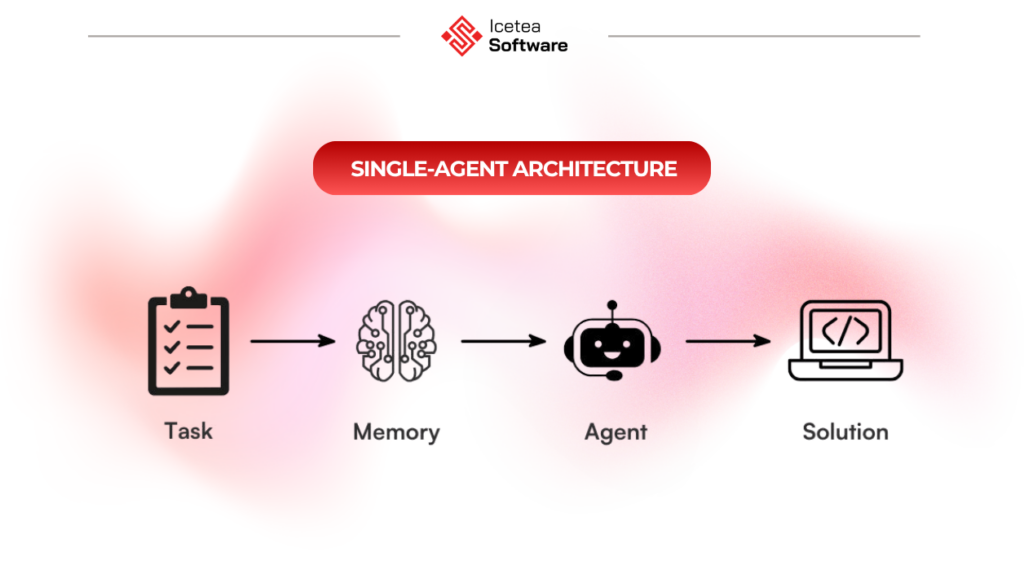
In a single-agent AI system, one AI instance handles everything: task planning, decision-making, tool execution, and response generation. This centralised architecture places a single reasoning loop in charge from start to finish. The agent can use multiple tools, make multiple model calls, and iterate on its outputs, but there’s one unified intelligence driving the entire process.
How a single-agent system works
The core loop of a single-agent system follows a Reason → Act → Observe → Repeat cycle, often referred to as a ReAct loop. At each step, the agent assesses the current state, decides on the next action, executes a tool call or computation, observes the result, and updates its plan accordingly. This continues until the goal is achieved or a stopping condition is met.
When single-agent systems work best
Single-agent systems excel in scenarios where tasks are well-defined, can be executed sequentially, and do not require specialized domain expertise. Key characteristics of ideal single-agent use cases:
Task complexity is moderate: the goal can be decomposed into a linear or lightly branching sequence of steps
The tool set is contained: the agent only needs access to a small, well-defined set of tools
Latency matters: single-agent systems avoid coordination overhead and return results faster
Budget is limited: one agent means one inference loop — significantly lower API and compute costs
The task is atomic: it does not benefit from parallelism or concurrent sub-task execution
A 2026 study demonstrated that a single agent on a well-defined task succeeded in all 28 consecutive attempts-remarkable reliability for production environments.
Real-world single-agent use cases
Code generation assistant: given a feature spec, the agent writes code, runs tests, and iterates on failures
Customer support agent: retrieves from a knowledge base and responds to user queries end-to-end
Document summarization pipeline: reads uploaded documents, extracts key points, and formats a summary
API integration agent: receives integration requirements and scaffolds the connector code
Bug triage agent: reads an error report, searches the codebase, identifies root cause, and suggests a fix
Single-agent system: key strengths and limitations
• STRENGTHS: Simple to build and deploy | Lower cost per task | Faster response time | Easier to debug and monitor | Sufficient for 70-80% of routine automation tasks
• LIMITATIONS: Context window can overflow on very long or complex tasks | Cannot parallelize work across specialized domains | Performance degrades as task scope expands | Single point of failure – no redundancy.
What Is a Multi-Agent System?
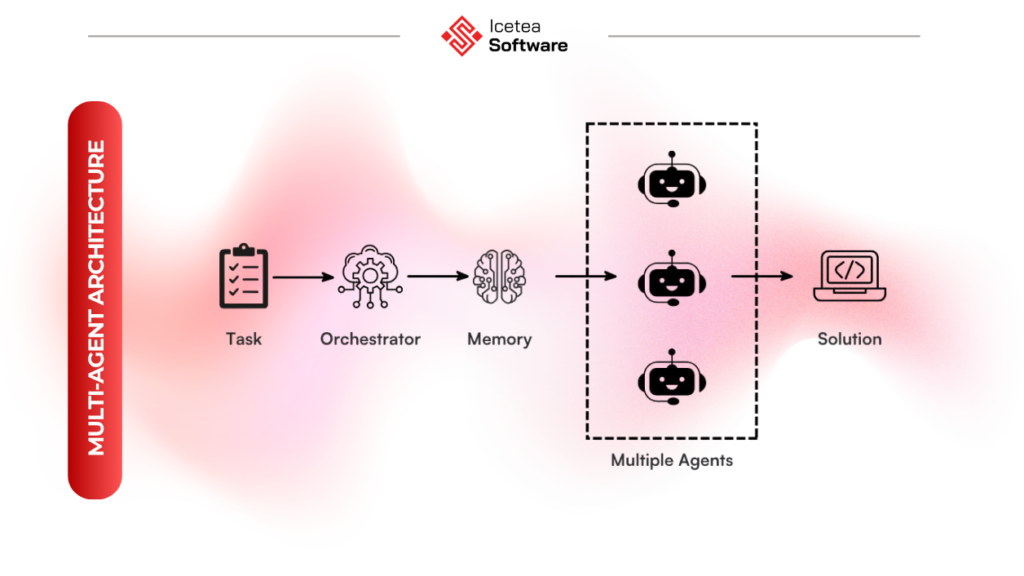
A multi-agent system is a coordinated network of two or more autonomous AI agents that work together to accomplish a shared goal. Each agent in the network typically has a specialized role, a distinct set of tools, and its own memory, and an orchestrator layer manages task delegation, context sharing, and result aggregation across the team.
Multi-agent systems consistently show 3-5x improvement in complex task completion compared to single-agent approaches.
Core components of a multi-agent architecture
Orchestrator agent: receives the high-level goal, decomposes it into subtasks, and delegates to sub-agents
Specialist sub-agents: each focuses on a defined domain (coding, testing, documentation, search, analysis)
Shared context layer: mechanisms for agents to pass outputs to each other and maintain shared state
Memory system: combination of individual agent memory and shared working memory across the pipeline• Human oversight interface: checkpoints where a human approves, reviews, or redirects agent actions
Communication patterns in multi-agent systems
How agents communicate and coordinate defines the architecture’s behavior and performance characteristics. There are three primary communication patterns:
Pattern
How It Works
Best For
Example
Sequential
Output of Agent A is input to Agent B, forming a linear pipeline
Well-defined workflows with clear handoffs
Spec → Code Agent → Test Agent → Doc Agent
Parallel
Multiple agents execute independent subtasks simultaneously, results merged at end
Tasks with independent sub-components
3 agents researching different market segments simultaneously
Hierarchical
Orchestrator delegates to specialist sub-agents, which may delegate further
Enterprise market research: parallel agents research different geographies, industries, or competitors simultaneously
Financial risk analysis: separate agents handle data ingestion, statistical modeling, regulatory cross-check, and report generation
Content production workflow: research agent → outline agent → writing agent → editing agent → SEO optimization agent
IT operations monitoring: detection agent, triage agent, remediation agent, and escalation agent working in a coordinated loop
Multi-agent system: key strengths and limitations
• STRENGTHS: Handles complex, long-horizon tasks | Specialization improves quality in each domain | Parallel execution reduces total time | Cross-agent validation increases reliability | Scales to enterprise-grade workflows
• LIMITATIONS: Higher cost – more inference calls, more orchestration overhead | Coordination errors: agents can pass incorrect context or contradict each other | Harder to debug – tracing failures across multiple agents requires robust logging | Slower to build and maintain | Risk of over-engineering simple tasks
Single-Agent vs Multi-Agent: Head-to-Head Comparison
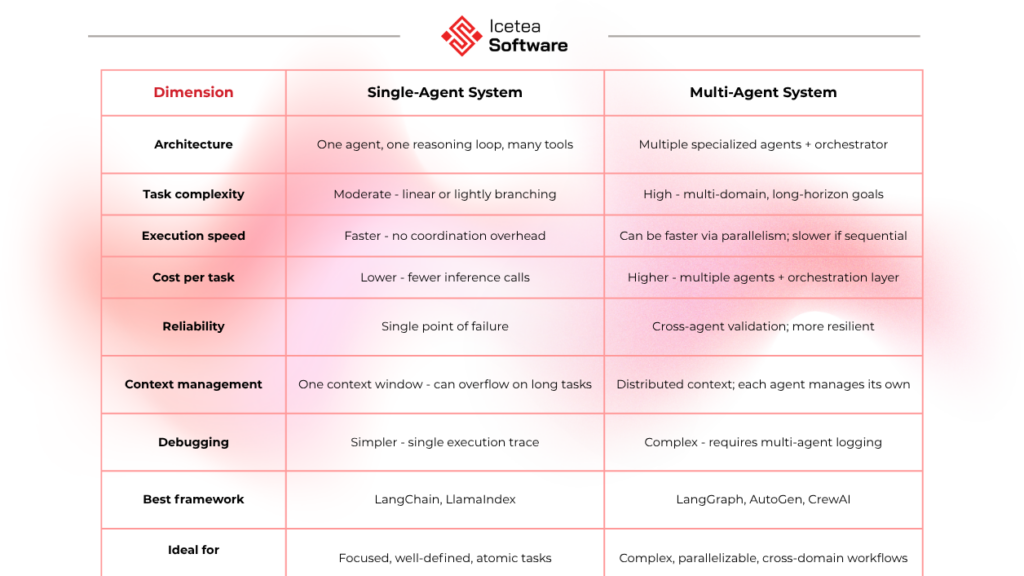
Understanding the differences between the two core types of agentic AI systems is critical for making the right architecture decision. The following table provides a direct comparison across nine dimensions that matter most in production deployments.
Choosing the Right Architecture – A Practical Decision Framework
With two distinctly different types of Agentic AI, how do you choose?
Go Single-Agent When…
✅ Your task is contained and well-understood with a clear linear flow
✅ Speed and simplicity are top priorities
✅ You have a limited budget or computing resources
✅ Your team needs something that’s easy to test, audit, and debug right away
✅ You’re new to Agentic AI and want a safe starting point
Single-agent systems are cheaper to run, faster to ship, and dramatically easier to audit. If something goes wrong, there’s one decision loop to trace.
Go Multi-Agent When…
✅ The problem naturally breaks into distinct expertise domains
✅ You need parallel processing across different data sources
✅ Fault tolerance is critical for business continuity
✅ You’re ready to invest in coordination infrastructure and observability
✅ The expected performance gains justify higher resource consumption
Beware of the vendor hype. More agents do not equal more power-that assumption “has a body count of failed AI projects behind it”.
Hybrid Approaches
Many successful implementations use a hybrid model that combines both architectures: simple deterministic agents for predictable tasks, multi-agent coordination only where complexity demands it, human-in-the-loop checkpoints at critical decision points, and single-agent fallbacks when multi-agent coordination fails.
Available Agentic AI Frameworks
Several frameworks make building these systems accessible:
Microsoft AutoGen – Conversation-first multi-agent collaboration; agents communicate via structured chats, ideal for exploratory tasks
LangChain / LangGraph – Modular LLM chaining with deterministic pipelines; excellent for RAG and production workflows
CrewAI – Role-based agent orchestration for enterprise workflows
Azure AI Foundry Agent Service – Enterprise platform for building and orchestrating intelligent agents at scale
Conclusion: Choosing the Right Type of Agentic AI Starts With Understanding the Task
The types of agentic AI systems available today – from lean, fast single-agent solutions to sophisticated multi-agent pipelines – give technology teams more architectural flexibility than ever before. But that flexibility comes with the responsibility to match architecture to task complexity honestly, not aspirationally. The best-performing agentic AI deployments in 2026 share a common trait: they started simple, validated value quickly, and added complexity only when the evidence demanded it.
Here’s your actionable takeaway:
If you’re new to Agentic AI – Start with a single-agent system on a well-scoped problem. Get it working, test it thoroughly, and build confidence before adding complexity.
If you have clear domain separation – Multi-agent architecture is likely your path to breakthrough performance.
Never choose architecture based on hype – Let your problem and constraints guide the decision.
Agentic AI is reshaping how work gets done across every industry. Ready to take the next step? Share this guide with your team, or drop a comment below with your specific use case. Let’s build something intelligent together.
Get in touch with our team to explore tailored solutions that combine deep technical expertise with a practical understanding of enterprise needs.
————————————————————————
Icetea Software – Revolutionize Your Tech Journey!
To provide the best experiences, we use technologies like cookies to store and/or access device information. Consenting to these technologies will allow us to process data such as browsing behavior or unique IDs on this site. Not consenting or withdrawing consent, may adversely affect certain features and functions.
Functional
Always active
The technical storage or access is strictly necessary for the legitimate purpose of enabling the use of a specific service explicitly requested by the subscriber or user, or for the sole purpose of carrying out the transmission of a communication over an electronic communications network.
Preferences
The technical storage or access is necessary for the legitimate purpose of storing preferences that are not requested by the subscriber or user.
Statistics
The technical storage or access that is used exclusively for statistical purposes.The technical storage or access that is used exclusively for anonymous statistical purposes. Without a subpoena, voluntary compliance on the part of your Internet Service Provider, or additional records from a third party, information stored or retrieved for this purpose alone cannot usually be used to identify you.
Marketing
The technical storage or access is required to create user profiles to send advertising, or to track the user on a website or across several websites for similar marketing purposes.

 YenDH
YenDH