How Agentic AI Will Transform Software Outsourcing by 2030?
 YenDH
YenDH
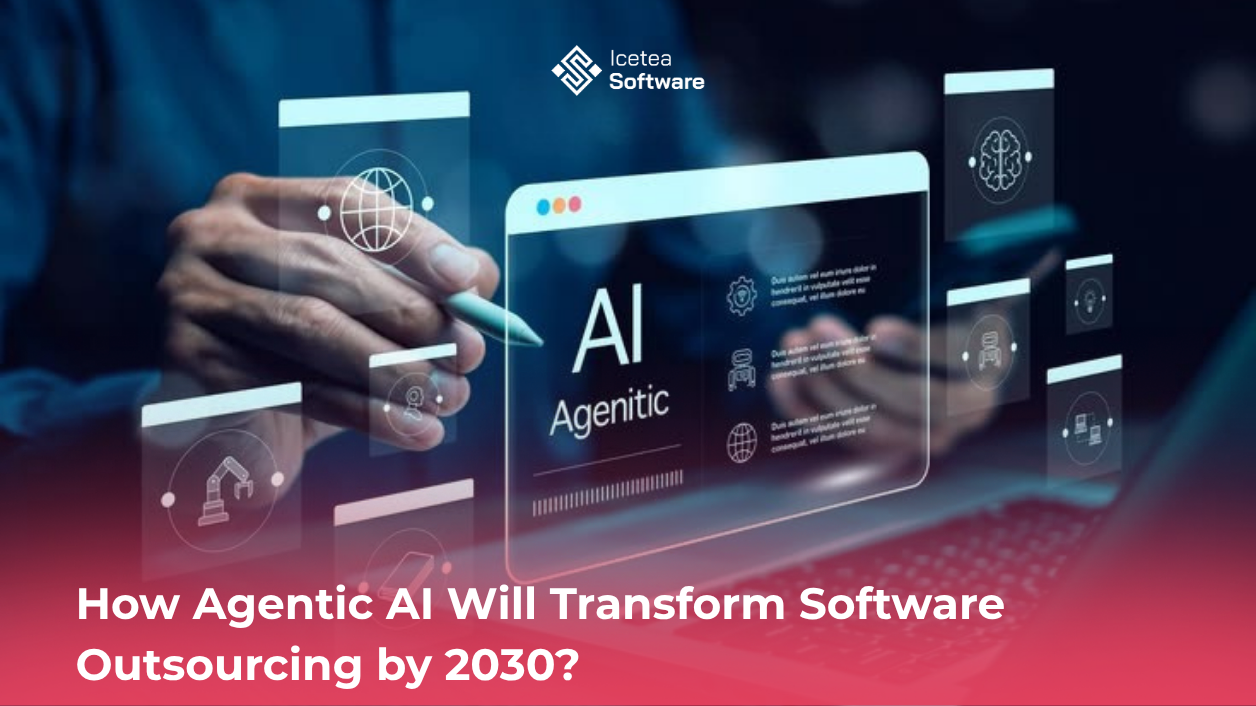
Software outsourcing has powered global product development for decades – but a fundamental disruption is already underway. Agentic AI, the next evolution of artificial intelligence in which autonomous agents plan, reason, and execute complex tasks independently, is rapidly moving from research labs to production software teams. Unlike basic AI assistants that respond to prompts, agentic AI systems proactively break down goals, use tools, coordinate with other agents, and deliver outcomes with minimal human intervention. For technology companies, startups, and enterprises that rely on outsourcing partners, this shift changes everything: what gets outsourced, how teams are structured, how costs are calculated, and what kind of partner you need to stay competitive. This guide explores exactly how agentic AI will reshape software outsourcing by 2030 – and what business leaders must do today to prepare.
Understanding Agentic AI: Beyond Automation
To understand how agentic AI will transform outsourcing, it helps to first distinguish it from the AI tools most businesses already use. Most AI deployments today – including large language model (LLM) chatbots, code completers, and document summarizers – are reactive. They respond to a prompt and produce output. They have no persistent memory, cannot take follow-up actions in the world, and stop when the conversation ends.
Agentic AI is architecturally different. An agentic AI system is designed to pursue goals autonomously over time. It can decompose a high-level objective into subtasks, select and use external tools (APIs, databases, code executors), remember context across sessions, and self-correct when it encounters an error. In a software development context, this means an agentic AI can receive a product requirement, write the initial code, run tests, debug failures, open a pull request, and notify a human reviewer – all without step-by-step instruction.
Key characteristics that define agentic AI systems:
- Goal-directed behavior: pursues outcomes, not just single responses
- Tool use: interacts with APIs, databases, browsers, and code environments
- Memory: retains context across sessions and tasks
- Planning: breaks complex objectives into ordered subtasks
- Self-correction: identifies errors and retries with adjusted strategies
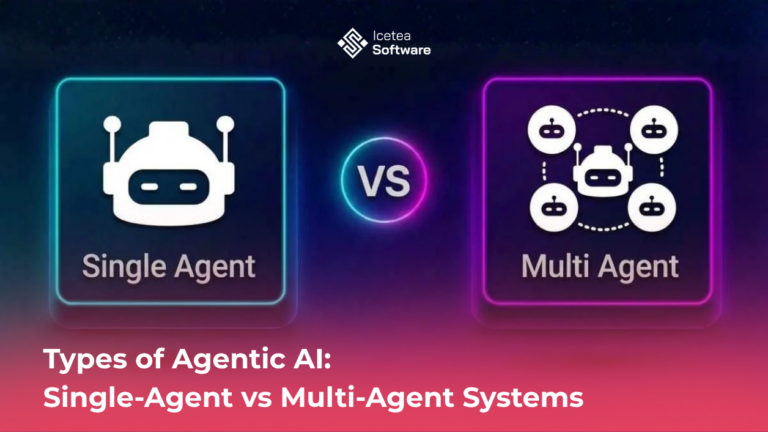
- Multi-agent coordination: delegates work to specialized sub-agents
Key insight
• According to Gartner, by 2028, at least 15% of day-to-day work decisions will be made autonomously through agentic AI. For software outsourcing teams, that figure is likely to be significantly higher.
• Market research from MarketsandMarkets estimates the AI agents market will grow from $7.84 billion in 2025 to $52.62 billion by 2030 – a CAGR of 46.3%.
The numbers behind the shift
| $52.62B AI agents market by 2030 (MarketsandMarkets) | 46.3% Projected CAGR 2025-2030 |
| 15%+ Daily decisions made by AI agents by 2028 (Gartner) | 70% Enterprises piloting AI agents in dev workflows by 2026 (IDC) |
How Agentic AI Will Specifically Reshape Software Outsourcing?
The impact of agentic AI on software outsourcing will not arrive in one wave – it is already underway in several dimensions simultaneously. Understanding each dimension helps business leaders anticipate where their current outsourcing model is most vulnerable to disruption, and where the greatest opportunities for competitive advantage lie.
1. The shift from hourly billing to outcome-based delivery
Traditional software outsourcing is built on a time-and-materials model: you pay for developer hours, and output is measured in lines of code, story points, or sprint velocity. Agentic AI fundamentally disrupts this model because agents are not constrained by working hours and can execute repetitive development tasks – unit test generation, boilerplate code, API integration, documentation – continuously and at near-zero marginal cost.
Forward-thinking outsourcing providers are already moving toward outcome-based pricing: you pay for a working feature, a passing test suite, or a deployed module – not for the hours spent producing it. By 2030, the most competitive outsourcing firms will price their services almost entirely on outcomes, with agentic AI handling the bulk of execution while human engineers focus on architecture, product judgment, and edge case resolution.
2. Automated quality assurance and testing pipelines
Quality assurance represents one of the largest cost centers in software outsourcing – typically 20-30% of total project cost. Agentic AI is already demonstrating the ability to generate comprehensive test suites, run regression tests, identify root causes of failures, and propose targeted fixes, all within a single automated pipeline.
Outsourcing providers that integrate AI-driven QA agents into their delivery workflow gain a high cost and speed advantage. Rather than a separate QA phase after development, testing becomes continuous, embedded in the coding loop. By 2027, leading outsourcing providers are projected to reduce QA turnaround time by 60-75% through agentic automation.
3. Multi-agent development pipelines replacing single-role contractors
One of the most structurally significant changes is the emergence of multi-agent development pipelines, where specialized AI sub-agents handle distinct parts of the software development lifecycle in coordination. A typical pipeline might include a requirements agent (parses and clarifies specs), an architecture agent (designs system structure), a coding agent (writes and refactors code), a testing agent (writes and runs tests), and a documentation agent (produces technical docs) – all orchestrated by a senior engineer or delivery manager.
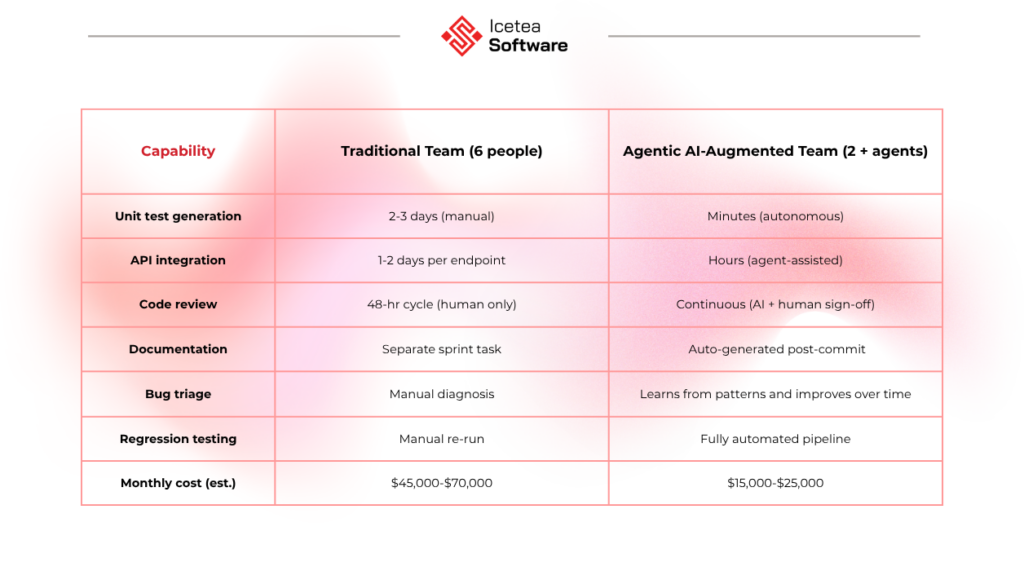
In this model, a single experienced engineer at an outsourcing provider can manage a pipeline that previously required a team of four to six people. The implications for the outsourcing industry are profound: team sizes shrink, unit economics improve dramatically, and client delivery timelines compress.
Traditional team vs. agentic AI-augmented team – a comparison
4. The redefinition of the outsourcing partner’s value proposition
As agentic AI commoditizes execution-layer development tasks, the competitive differentiation of outsourcing providers will shift dramatically. By 2030, the most valuable outsourcing partners will not be those with the largest pools of developers – they will be those with the deepest AI integration capabilities, the best-trained agent workflows, and the strongest domain expertise to guide AI agents in high-complexity environments.
For technology companies evaluating outsourcing partners in markets like Singapore and the United States, this means the selection criteria are changing. Technical headcount matters less; AI capability maturity, proprietary agent tooling, and proven AI-augmented delivery track records matter more.
5. Cost reduction at scale: what the numbers look like
The cost implications for businesses that partner with AI-native outsourcing providers are substantial. Based on current trajectories and early adopter benchmarks, here is what the economics look like for a mid-sized software development engagement:
Projected cost impact of agentic AI in software outsourcing (2026-2030)
- QA and testing costs: -60 to -75% reduction through autonomous testing agents
- Documentation overhead: -80% reduction through auto-generated technical docs
- Boilerplate and scaffolding code: -70% reduction through agentic code generation
- Bug resolution time: -50% reduction through AI-assisted root cause analysis
- Total project cost (typical SaaS build): 30-45% lower with AI-augmented teams
- Time-to-market: 25-40% faster delivery for well-scoped projects
What This Means for Businesses
The shift toward agentic AI-powered outsourcing carries different implications depending on a company’s geography, sector, and current outsourcing maturity.
Opportunities
- Faster time-to-market: AI-augmented outsourcing teams deliver MVPs and feature releases significantly faster, compressing go-to-market timelines for product companies
- Access to AI-native talent: partnering with AI-forward outsourcing providers gives companies access to cutting-edge agentic AI capabilities without the cost of building in-house AI infrastructure
- Scalability without headcount: agentic AI pipelines can scale output dramatically without proportional increases in team size or cost
- 24/7 development cycles: AI agents operate continuously, enabling true round-the-clock development that leverages global time zones more efficiently than traditional staff augmentation
- Improved code quality: systematic agent-driven code review and testing often produce fewer defects than purely human-driven QA processes
Risks businesses must manage
- Vendor capability gap: not all outsourcing providers claiming ‘AI integration’ have genuine agentic AI capabilities – due diligence is critical
- Security and IP exposure: agentic systems with broad tool access require robust permission controls and data handling policies
- Over-automation without oversight: agentic pipelines without human checkpoints can compound errors rapidly at scale
- Regulatory compliance: in regulated sectors (finance, healthcare), autonomous agent actions must satisfy audit trail and explainability requirements
- Transition risk: migrating from a traditional outsourcing model to an AI-augmented model requires careful change management and knowledge transfer
What Businesses Should Do Right Now
The window between early adoption and mainstream adoption of agentic AI in software outsourcing is narrowing fast. Businesses that act in 2026 will capture a meaningful competitive advantage over those that wait until 2027 or 2028 when the shift becomes unavoidable. Here is a practical action plan organized by time horizon:
Immediate (0-6 months)
- Audit your current outsourcing arrangements: identify which workflows are most amenable to agentic automation (testing, documentation, boilerplate coding)
- Evaluate your outsourcing partners’ AI maturity: use the five questions above as a starting framework
- Run a pilot: commission a focused agentic AI pilot on a low-risk internal project to build organizational familiarity
- Establish AI governance basics: define your acceptable-use policy, data-handling rules, and human-oversight requirements for AI-generated code.
Medium term (6-18 months)
- Transition QA and testing to AI-augmented pipelines: this is typically the highest-ROI first step
- Shift to outcome-based contracts: work with your outsourcing partner to pilot feature-based or milestone-based pricing
- Upskill internal stakeholders: product managers and engineering leads need to understand how to scope work for AI-augmented teams
- Expand agent use cases: from QA, move into documentation, code review, and API integration automation
Long term (18 months-2030)
- Build or partner for full multi-agent delivery pipelines: position your outsourcing model around AI-native teams
- Develop proprietary domain knowledge layers: the organizations that win will be those whose AI agents are fine-tuned on their specific domain, stack, and codebase
- Integrate agentic AI into product strategy, not just development: by 2030, the product-development boundary will blur as AI agents participate in requirements, design, and post-launch optimization
The Future of Software Outsourcing Is Agentic
The transformation of software outsourcing by agentic AI is not a distant scenario – it is happening now, and the pace is accelerating. By 2030, the industry will look fundamentally different: smaller, more specialized teams augmented by autonomous agent pipelines will deliver more software, faster, and at lower cost than today’s traditional models. For businesses globally, the question is not whether to adapt to agentic AI-powered outsourcing, but how quickly to act.
The outsourcing providers that invest in agentic AI capabilities today – building genuine multi-agent delivery pipelines, developing AI governance frameworks, and transitioning to outcome-based pricing – will define the competitive standard for the rest of the decade. Those who treat AI as a marketing term without investing in real capability will be displaced.
If you’re considering how agentic AI can fit into your organization, or how an IT outsourcing partner can help you bring it to life, we’re here to support that journey.
Get in touch with our team to explore tailored solutions that combine deep technical expertise with a practical understanding of enterprise needs.
————————————————————————
Icetea Software – Revolutionize Your Tech Journey!
Website: iceteasoftware.com
LinkedIn: linkedin.com/company/iceteasoftware
Facebook: Icetea Software