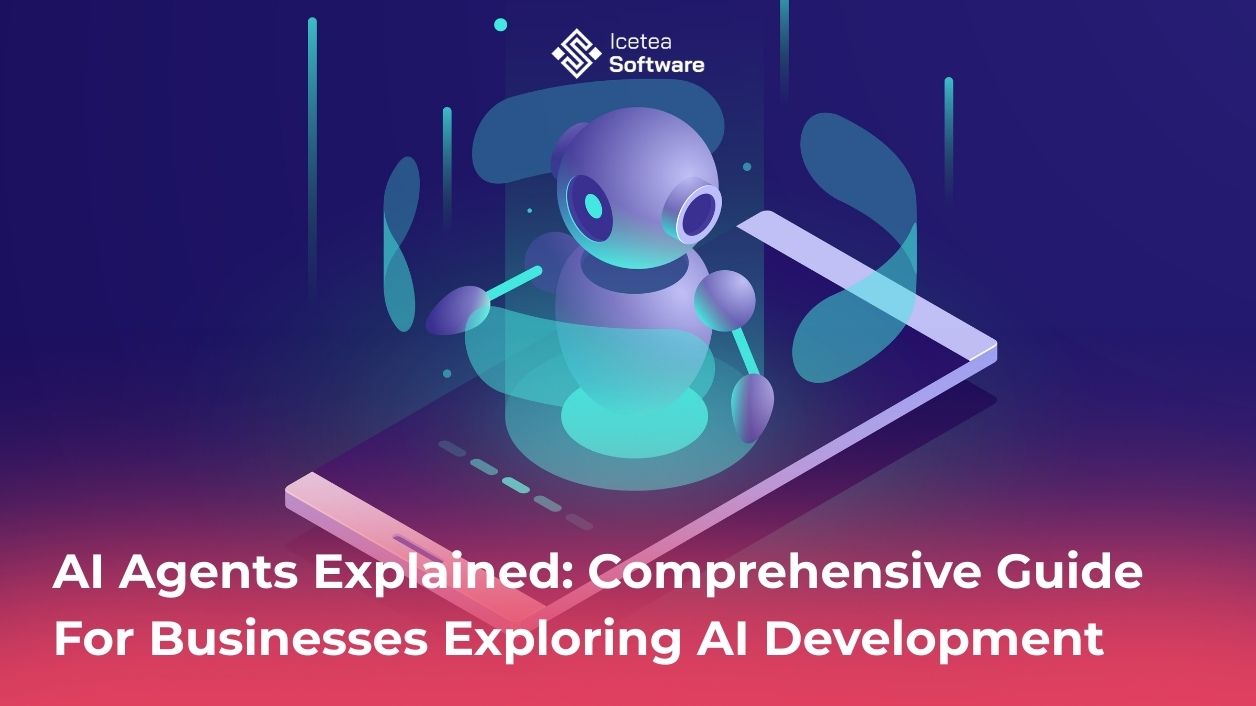
AI Agents Explained: A Comprehensive Guide For Businesses Exploring AI Development
 YenDH
YenDH
AI agents explained often start with a critical question: If your organization already has access to real-time analytics, why does execution still lag behind insight? While dashboards surface patterns and predictive models forecast outcomes, translating those signals into timely, consistent action remains a structural challenge in many enterprises.
A closer look at AI agents reveals a shift from intelligence as observation to intelligence as operation. Rather than functioning solely as analytical layers, AI agents are architected to interpret dynamic inputs, evaluate alternatives, and trigger predefined responses within governed boundaries. For businesses exploring AI development services, the strategic value lies in embedding adaptive decision logic directly into workflows, so responsiveness becomes systematic rather than situational.
What is an AI Agent?
At a practical level, an AI agent is a system that can:
- Perceive its environment
- Process contextual information
- Make decisions aligned with specific goals
- Execute actions autonomously
- Improve performance through feedback
What differentiates AI agents from traditional software is intentionality. Conventional systems execute predefined logic. AI agents evaluate possible actions against objectives and constraints before acting.
For example, a rule-based pricing system may adjust prices when inventory drops below a threshold. An AI agent, by contrast, continuously analyzes demand elasticity, competitor pricing signals, margin targets, and customer behavior patterns before determining optimal pricing adjustments. The distinction is subtle but strategically important.
How an AI Agent Operates?
To properly frame AI agents explained, it is helpful to examine the intelligence loop that drives agent-based systems. While implementations vary, most enterprise AI agents operate through 5 independent stages:
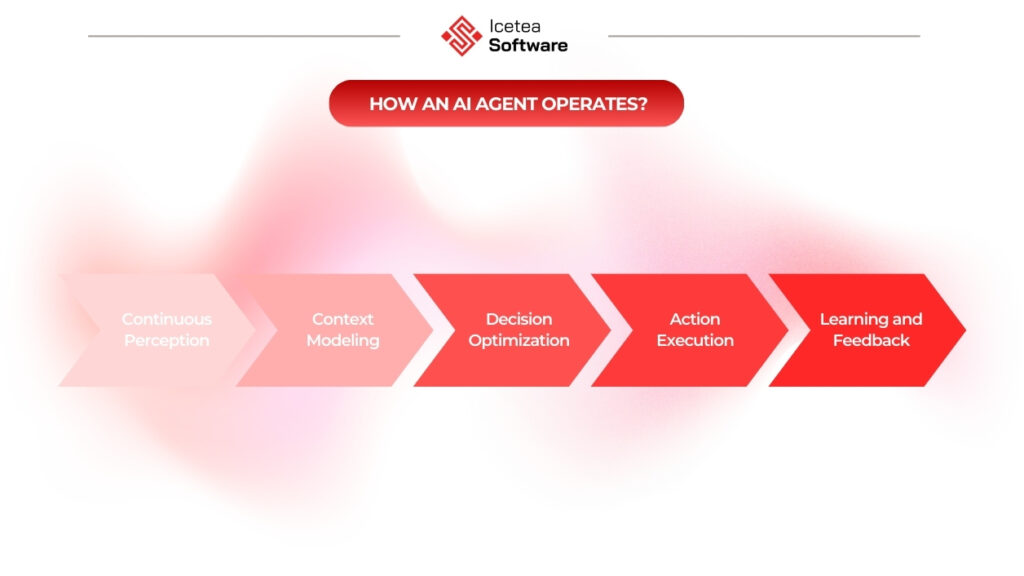
1. Continuous Perception
AI agents’ data streams from ERP systems, CRM platforms, APIs, IoT devices, and external market feeds. Unlike static reporting tools, AI agents function within live operational environments.
2. Context Modeling
More advanced AI agents maintain an internal representation of the environment. Model-based AI agents, for instance, simulate future states before making decisions. In supply chain management, this might involve forecasting inventory levels under different demand scenarios.
3. Decision Optimization
Depending on the architecture, decision logic may rely on:
- Rule-based systems
- Probabilistic modeling
- Reinforcement learning
- Utility optimization
Reinforcement learning research from DeepMind demonstrated how AI agents learn optimal strategies through iterative feedback in AlphaGo (Nature, 2016). While enterprise applications are less dramatic, the same learning principles underpin dynamic pricing engines and fraud detection systems.
4. Action Execution
AI agents act within predefined governance boundaries. Actions may include reallocating ad budgets, triggering procurement workflows, adjusting delivery routes, or deploying software updates.
5. Learning and Feedback
Continuous learning differentiates high-performing AI agents from static automation tools. According to McKinsey & Company’s State of AI 2023 report, organizations that actively monitor AI performance are significantly more likely to report revenue increases and cost reductions.
AI Agents vs Traditional AI Systems
Traditional AI is like a specialist you call when you need a specific answer. You bring a problem, receive a solution, and move on. The interaction is clear, contained, and transactional. It strengthens individual decisions but does not stay involved once that decision is made.
AI agents resemble an operations coordinator embedded inside the system. They do not wait to be consulted for every step. Instead, they observe activity continuously, recognize patterns across events, and intervene when predefined objectives drift off course. Rather than solving a single problem, they maintain direction over time.
The contrast becomes clearer in practice. A conventional AI model might predict sales for the next quarter. An AI agent would monitor those projections, track real-time performance, adjust procurement signals, flag supply risks, and re-prioritize actions when deviations occur. One delivers insight, the other sustains alignment.
6 Types of AI Agents and Their Strategic Roles
Not all AI agents operate at the same level of intelligence or autonomy. The architectural choice should reflect operational complexity, acceptable risk exposure, and the degree of decision independence required. Below are the primary categories most businesses encounter when exploring AI development.
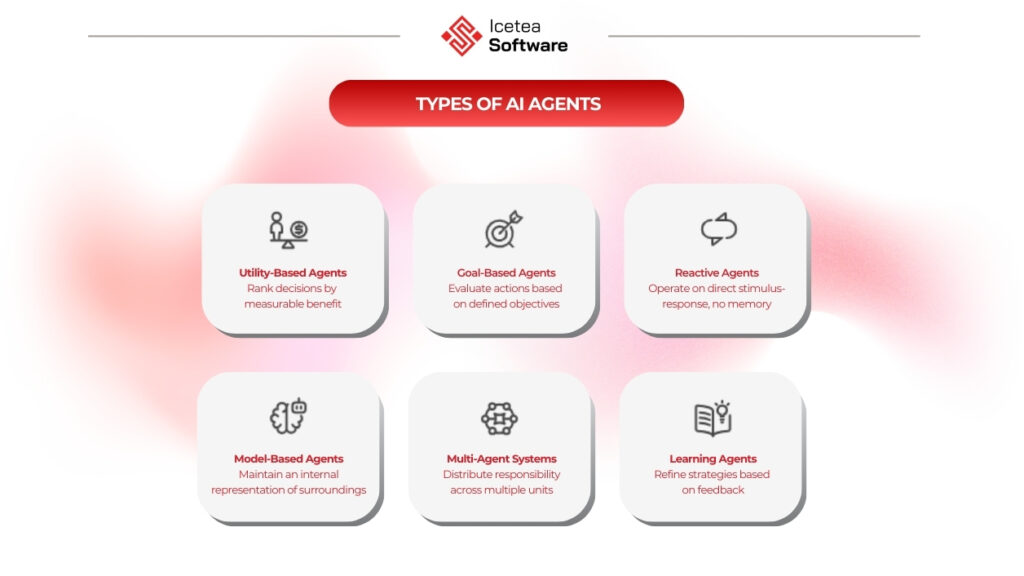
Reactive Agents
Reactive agents operate on direct stimulus-response logic. They do not retain historical memory or construct internal simulations of future states. When a predefined condition is met, the system executes a corresponding action.
Fraud detection systems that trigger alerts when transactions exceed anomaly thresholds are a common example. These AI agents are computationally efficient and predictable, making them suitable for tightly scoped tasks. However, their limitation lies in the absence of foresight or contextual reasoning.
Model-Based Agents
Where reactive systems stop at immediate input, model-based agents maintain an internal representation of their surroundings. They incorporate historical context and evolving variables into their reasoning process.
Consider a logistics platform recalculating shipping routes. Instead of responding to traffic congestion alone, the AI agent factors in weather patterns, fuel pricing, and delivery deadlines before adjusting distribution paths.
Goal-Based Agents
Goal-based agents introduce intentionality. Rather than simply responding to conditions, they evaluate alternative courses of action in relation to a defined objective.
In a DevOps pipeline, for example, the system may weigh faster deployment against potential service instability. The selected action is determined by which option most effectively advances the intended outcome. The architecture becomes especially valuable when trade-offs cannot be resolved through fixed rules.
Utility-Based Agents
Utility-based agents formalize trade-offs by assigning quantitative value to each potential outcome. Decisions are not only aligned with goals but also ranked according to measurable benefit.
In portfolio management, risk exposure and projected return are translated into comparative scores before rebalancing assets. According to PwC, AI could contribute up to $15.7 trillion to global GDP by 2030, with optimization-driven systems playing a central role in that growth.
Multi-Agent Systems
Certain environments exceed the capacity of a single decision-making entity. Multi-agent systems distribute responsibility across multiple autonomous units that coordinate or compete within shared parameters.
Applications range from supply chain orchestration to smart grid management. The AI Index Report from Stanford University highlights increasing investment in distributed AI agent frameworks, particularly for complex, interdependent decision ecosystems where centralized control becomes inefficient.
Learning Agents
Learning agents introduce adaptability over time. Instead of relying solely on preconfigured logic, they refine their strategies based on feedback and performance outcomes.
AI-assisted development tools built on models from OpenAI demonstrate this adaptive capability. Research published by GitHub reported developers completing tasks up to 55% faster with AI assistance, illustrating how iterative learning mechanisms can produce tangible productivity gains.
Use Cases of AI Agents Across Industries
AI agents rarely sit on the surface of an organization. They tend to operate in the background, inside transaction streams, production systems, or customer journeys, where decisions must be made continuously and without interruption. Their impact varies by how much authority the business is willing to delegate to software.
Financial Services
In capital markets, hesitation is expensive. A delayed fraud alert, a mispriced derivative, or an unbalanced portfolio can compound losses quickly. AI agents in this space function as continuous evaluators embedded directly into financial infrastructure.
They commonly handle:
- Transaction-level fraud prevention: Where behavioral patterns, geolocation mismatches, and transaction velocity are analyzed simultaneously before approval
- Automated portfolio adjustments: Triggered when volatility bands, liquidity thresholds, or risk exposure exceed predefined tolerances
- Dynamic credit evaluation: Incorporating cash-flow signals and alternative data rather than relying solely on static credit scores
The value here is the compression of reaction time in environments where exposure changes by the second. As noted by PwC, AI-driven optimization systems are projected to contribute up to $15.7 trillion to global GDP by 2030, with finance representing a significant share of that gain.
Healthcare
Healthcare operates under stricter thresholds of accountability than most industries. Here, the primary objective is not speed alone but reducing diagnostic ambiguity while preserving clinical oversight. AI agents are therefore integrated as decision-support layers, expanding analytical capacity without displacing medical authority.
They typically contribute in area such as:
- Emergency triage prioritization: When patient volume spikes, intake teams face information overload within minutes. AI systems can rapidly synthesize medical history, presenting symptoms, vital signs, and known risk factors to elevate high-acuity cases in the queue
- Radiology and medical imaging analysis: Imaging departments process large volumes of scans daily, often under significant time pressure. Computer vision models scan each image at granular resolution, marking subtle irregularities that might otherwise blend into routine cases
- Operational flow and capacity coordination: Hospital congestion rarely happens suddenly. Admission trends, discharge delays, and staffing gaps create pressure points that escalate if left unmanaged. AI-driven coordination tools anticipate these shifts by correlating inflow patterns with resource availability, enabling earlier redistribution of beds or personnel before overcrowding becomes critical
Unlike in financial systems, these AI agents rarely execute irreversible actions independently. Instead, they filter noise, organize complex clinical data, and elevate high-risk signals, allowing practitioners to devote more time to nuanced medical reasoning rather than repetitive screening tasks.
Ecommerce and Retail
Retail profitability is decided in fragments, a few percentage points on price, a slightly higher cart value, or a replenishment order placed one day too late. None of these variables operate in isolation, and none wait for manual review cycles.
AI agents enter at the points where hesitation becomes expensive:
- When price becomes a moving target: Competitor discounts, demand spikes, and inventory pressure can distort margin within hours. Instead of relying on scheduled updates, AI continuously recalculates viable price ranges, preserving contribution margin while still capturing conversion momentum
- When customer intent shifts mid-session: A shopper who begins browsing entry-level products may pivot to premium alternatives after viewing reviews or bundles. Static recommendation logic cannot follow that shift fast enough. AI systems reassemble product suggestions in-session, aligning with emerging intent rather than historical averages
- When inventory misalignment starts silently: Revenue leakage often starts before dashboards flag a problem. Fast-moving SKUs in one region, slow turnover in another, delayed supplier timelines, these small mismatches compound. AI surfaces these imbalances early, prompting redistribution or replenishment before stockouts translate into abandoned carts
Manufacturing and Supply Chain
Industrial operations rarely fail dramatically at first. Pressure builds in one mode, latency creeps into another, and only when dependencies intersect does the disruption become visible. The challenge is that factories and logistics networks generate continuous telemetry, but the speed at which a local issue propagates across the chain.
AI systems intervene at points where timing determines resilience:
- Equipment signals before breakdowns surface: Vibration irregularities, temperature drift, micro-variations in output quality, these signals accumulate long before mechanical. Predictive models convert raw sensor streams into probability distributions of component fatigue, enabling maintenance decisions based on risk exposure rather than fixed intervals
- Routing decisions under volatile constraints: Freight congestion, fuel volatility, port delays, and weather disturbances reshape optimal routes daily. Static scheduling frameworks cannot re-optimize at the pace required. AI recalculates logistics paths in response to shifting constraints, balancing delivery time, cost efficiency, and contractual obligations simultaneously
- Local autonomy within global coordination: Large supply networks operate across distributed plants, warehouses, and transport hubs. Centralized control often introduces latency. Multi-agent systems allow individual nodes to adapt to local conditions, production slowdowns, inventory variance, and transport delays, while still aligning with system-wide throughput objectives
Research such as the AI Index Report from Stanford University notes increasing investment in multi-agent architectures specifically designed for these interdependent industrial environments.
Software Development and IT Operations
Every release cycle carries hidden costs: rework, review delays, debugging detours, and environment inconsistencies. None of these issues are unusual but resolving them consumes disproportionate time and attention.
AI is now woven directly into that stack, as an active participant in the development lifecycle:
- Inside the codebase: During implementation, AI models generate boilerplate structures, propose refactoring paths, and surface potential security weaknesses before the code reaches review. Developers spend less time reconstructing syntax and more time resolving architectural trade-offs.
- Across infrastructure elasticity: Traffic patterns rarely follow clean forecasts. When load deviates from projections, AI-driven monitoring systems trigger scaling decisions dynamically, allocating compute resources in response to real-time utilization metrics rather than static provisioning rules.
- Through incident analysis: Production anomalies often span multiple microservices. Instead of isolating logs manually across distributed components, AI-assisted diagnostics correlate traces, surface likely fault origins, and compress mean time to resolution before user-facing disruption expands.
A study published by GitHub found that developers using AI tools built on models from OpenAI completed certain tasks up to 55% faster. The implication extends beyond productivity metrics: output capacity scales without requiring linear growth in headcount.
Conclusion
By this point, you might be asking a practical question: “Where does this actually fit into my organization?” If it remains at the edges, generating reports, drafting content, forecasting scenarios, improvement will stay incremental. When it sits closer to execution, observing signals and maintaining alignment across moving parts, the effect becomes structural, coordination tightens, response cycles shorten, and stability improves under pressure.
If you are considering that next layer, moving from isolated AI deployments to sustained, AI agent-driven orchestration, this is the right moment to contact Icetea Software to explore it deliberately.
————————————————————————
Icetea Software – Revolutionize Your Tech Journey!
Website: iceteasoftware.com
LinkedIn: linkedin.com/company/iceteasoftware
Facebook: Icetea Software