In-House vs Outsourcing: Which One Is Suitable For Your Software Development?
 YenDH
YenDH
When enterprises plan a new digital product, one strategic question consistently appears: In-house vs outsourcing, which model delivers better value, lower risk, and stronger long-term scalability? For companies evaluating development in Vietnam, this decision becomes even more nuanced. Vietnam has positioned as a leading IT outsourcing destination in Asia, offering competitive rates, a rapidly growing talent pool, and strong technical education. Yet building an internal team may still be the right approach depending on business objectives.
Read more: IT Outsourcing in Vietnam: A Practical Look For Enterprises
This blog provides a comprehensive analysis of in-house vs outsourcing software development, supported by industry data and practical insights. We will examine each category in detail to help you determine which model aligns with your goals.
Understanding In-House Software Development
In-house development refers to building and managing your own internal software team, which includes hiring full-time developers, designers, QA engineers, DevOps specialists, and technical leadership who operate under your direct management structure.
An in-house team provides:
- Direct oversight and managerial control
- Deep alignment with company culture and internal processes
- Long-term product ownership and knowledge retention
- Physical or organizational proximity to business stakeholders
Organizations pursuing digital transformation or building core intellectual property often consider this model because it allows tighter integration between business and engineering.
However, maintaining an internal team requires significant investment in recruitment, onboarding, infrastructure, training, and employee retention.
According to the 2022 Global Outsourcing Survey by Deloitte, talent acquisition and retention remain one of the top operational challenges for technology-driven companies globally. This directly impacts organizations attempting to scale in-house teams in competitive labor markets.
Understanding IT Outsourcing

IT outsourcing involves partnering with an external vendor to handle part or all of your software development lifecycle. The vendor may operate offshore, nearshore, or onshore. Outsourcing models typically include:
- Dedicated development teams
- Project-based delivery
- Staff augmentation
- Build-Operate-Transfer (BOT) models
According to Statista, global IT outsourcing revenue is projected to surpass $400 billion in the coming years, reflecting sustained enterprise demand for external technology partnerships. This growth signals that outsourcing is no longer viewed solely as a costing-cutting tactic, but as a strategic lever for scalability and innovation.
In-house vs Outsourcing: A Detailed Comparison
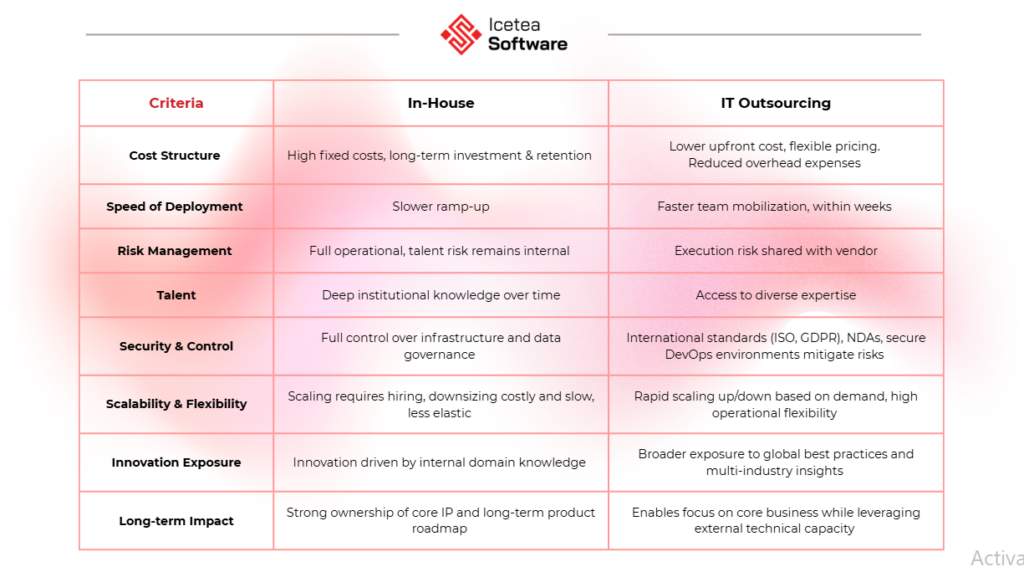
Cost Structure
In-house
An internal team requires:
- Base salary
- Social insurance and benefits
- Recruitment expenses
- Hardware and infrastructure
- Office space
- Training and Upskilling
- Management overhead
In developed markets such as the US or Western Europe, the average software engineer salary can exceed $100,000 annually. Even in emerging markets, total employment cost (including benefits) significantly exceeds base salary.
Outsourcing
Outsourcing vendors in Vietnam typically offer hourly rates ranging between $20-$40/hour for mid-level engineers, depending on complexity and specialization, which can help businesses reduce labor costs by 40-60%.
According to data from World Bank income statistics and global wage comparisons, labor cost disparities remain substantial between Southeast Asia and Western economies, reinforcing outsourcing’s financial appeal.
However, cost evaluation should consider:
- Communication overhead
- Vendor management
- Knowledge transfer
- Potential rework
In pure financial modeling, outsourcing often wins in short-to-mid-term cost efficiency. For long-term core systems, total cost of ownership must be carefully calculated.
Speed of Deployment
In-house
Building an internal team may take 3-6 months for recruitment alone, especially for senior engineers or niche expertise. Talent shortages in AI, cloud architecture, and cybersecurity exacerbate this timeline.
Outsourcing
Outsourcing vendors can deploy ready teams within weeks. Established Vietnamese IT companies maintain pre-vetted talent pools, allowing rapid ramp-up. Outsourcing typically enables faster MVP delivery and shorter product validation cycles. For startups or enterprises piloting new initiatives, outsourcing significantly reduces launch timelines.
Risk Management
In-house
With an in-house team, the organization assumes full operational and financial responsibility. Talent attrition is a primary concern, especially when senior engineers possess critical system knowledge. Replacing experienced developers can take months, potentially disrupting delivery timelines and product stability.
Additionally, fixed overhead remains constant regardless of market conditions. During economic downturns, maintaining a full internal engineering team can create financial strain. There is also the ongoing need to invest in upskilling to prevent technology obsolescence and capability gaps.
Outsourcing
Outsourcing reduces internal operational burden but introduces partnership-related risks. Communication gaps, cultural differences, and time zone coordination can affect efficiency if not properly managed. Vendor dependency may also limit flexibility of contractual terms are not clearly defined.
Talent Pool & Expertise
In-house
An internal team gradually accumulates strong institutional knowledge. Over time, engineers gain a deep understanding of your business logic, customer journeys, legacy systems, and long-term product vision.
However, building highly specialized capability in-house can be resource-intensive. Recruiting experts in areas such as AI/ML engineering, blockchain architecture, cloud-native DevOps, or cybersecurity often involves high salary expectations and lengthy hiring cycles.
Outsourcing
Outsourcing, particularly in markets like Vietnam, offers broader access to diversified technical skill sets. Vietnam has around 60,000 of IT graduates annually, contributing to a rapidly expanding technology workforce. Established outsourcing companies maintain multidisciplinary teams serving industries such as fintech, healthcare, e-commerce, and SaaS. As a result, outsourcing companies often bring:
- Cross-industry best practices drawn from multiple client engagements
- Experience delivering projects for global markets
- Early adoption of emerging technologies and frameworks
Security and Data Protection
In-house
Developing software internally allows companies to maintain direct authority over infrastructure, access management, and compliance processes. All data flows, system permissions, and internal protocols remain under centralized control. This structured can simplify audits and regulatory alignment, which is why industries such as finance, defense, and public administration frequently prefer in-house development models.
That said, security strength is not automatically guaranteed by keeping development internal. It depends on the organization’s cybersecurity investment, governance discipline, and technical maturity. Without continuous monitoring, patch management, and policy enforcement, internal environments can still face significant vulnerabilities.
Outsourcing
In outsourcing arrangements, security becomes a shared responsibility between client and vendor. Reputable Vietnamese IT outsourcing companies adhere to:
- ISO 27001 standards
- GDPR compliance frameworks
- NDA and IP protection agreements
Moreover, many companies provide segregated development environments, controlled access systems, and audited workflows to protect client assets.
Control and Governance
In-house
With an in-house team, control is direct and operational. Leadership sets priorities, defines coding standards, approves architectural directions, and evaluates team performance on a daily basis. Because communication flows within the same organizational structure, decision-making cycles are typically shorter, and adjustments can be implemented immediately
Outsourcing
In outsourcing models, control shifts from managerial oversight to structured governance. Rather than supervising individuals directly, organizations manage performance through contractual agreements, defined deliverables, service-level expectations, and measurable KPIs. Effective outsourcing depends on clear communication channels, transparent sprint reviews, well-defined documentation standards, and regular reporting mechanisms.
Scalability and Flexibility
In-house
Scaling an internal team is often a structured and time-consuming process. It typically requires:
- Recruiting cycles and technical screening
- Budget approvals and headcount planning
- Onboarding and training time
While this approach builds long-term stability, it reduces short-term agility. Downsizing is even more complex. Workforce reductions can be financially costly and may negatively affect company culture and team morale. As a result, in-house scalability tends to be less elastic and slower to adjust to sudden market changes.
Outsourcing
Outsourcing offers a more flexible resource model. Established companies can scale teams based on project needs, often within weeks rather than months. This allow companies to:
- Rapidly expand development capacity
- Adjust resource allocation according to workload
- Optimize costs more easily during slow periods
Which Projects Fit Each Model?
Projects Best Suited for In-House Development
In-house teams typically more appropriate for projects that sit at the core of a company’s competitive advantage. These include:
- Core intellectual property platforms that define the company’s market differentiation
- Proprietary algorithms or AI models that must remain tightly controlled
- Long-term R&D programs requiring continuous iteration and internal knowledge accumulation
- Highly confidential systems in regulated industries such as government, defense, or banking
- Deeply integrated enterprise ERP or internal platforms embedded across multiple business units
In these scenarios, maintaining direct oversight ensures stronger alignment with strategic goals and protects critical knowledge assets.
Project Best Suited for Outsourcing Development
Outsourcing is often more effective for projects where speed, flexibility, and cost optimization are priorities. Typical examples include:
- MVP development for startups validating product-market fit
- Legacy system modernization and refactoring
- Mobile and web application development
- QA, testing automation, and maintenance services
- Cloud migration and DevOps implementation
- Short-term digital transformation initiatives with defined scope
For companies expanding into Southeast Asia or aiming to optimize development costs, outsourcing to Vietnam can provide access to skilled engineering talent while maintaining budget efficiency and scalability.
Read more: Top 10 IT Outsourcing Companies in Vietnam: A Deep Dive for 2026
Hybrid Approach: The Emerging Standard
In the practical debate of in-house vs outsourcing development, many organizations no longer treat the choice as either-or. Instead, they combine both models to optimize performance and risk balance.
- Core architecture and product strategy remain in-house to protect intellectual property and ensure long-term alignment
- Feature development and scaling activities are outsourced to increase speed and resource flexibility
- QA, testing, and maintenance are often handled offshore to optimize operational cost
With the broader in in-house vs outsourcing discussion, the hybrid approach has become a practical standard, balancing governance, cost efficiency, and scalability without committing fully to one structure.
Conclusion
There is no right answer in the in-house vs outsourcing debate, only context. Some companies need tight control deep product immersion, and long-term capability-built from within. Others prioritized speed, flexibility, and the ability to scale resources up or down without heavy structural commitments.
Increasingly, the smartest move is not choosing sides but choosing balance. The model you adopt should reflect where your business stands today, and where you intend to take it tomorrow.
If you are evaluating the right structure for your next software initiative, contact Icetea Software to explore a solution tailored to your strategic goals and growth roadmap.
————————————————————————
Icetea Software – Revolutionize Your Tech Journey!
Website: iceteasoftware.com
LinkedIn: linkedin.com/company/iceteasoftware
Facebook: Icetea Software