AI Automation Explained: How It Transforms Modern Businesses
 YenDH
YenDH
AI automation is supposed to make operations more efficient, but why do so many teams still feel overwhelmed after implementing it? More tools. More workflows. More automation layers. And yet, decisions are still slow, edge cases keep piling up, and teams are constantly stepping in to “fix” what automation was supposed to handle.
AI automation approaches the problem differently. Instead of locking decisions into predefined paths, it introduces systems that can adjust based on data and outcomes as they unfold. The process is no longer something you fully design upfront, it becomes something that evolves.
That shift may seem subtle, but it changes how businesses scale, optimize, and make decisions. In this article, we’ll look at what AI automation actually means in practice, how it works, and what it takes to apply it in a way that creates real impact.
A Clearer Way to Understand AI Automation
To make sense of AI automation, it is more useful to look at how automation has been designed in practice rather than starting from a definition. Most systems today are built on the assumption that processes can be fully specified in advance, where each condition is mapped out, and every possible outcome is anticipated. As long as operations remain stable and predictable, this approach works reliably and at scale.
The limitation becomes visible when that predictability starts to fade. As inputs grow more varied and edge cases become part of everyday operations, maintaining performance requires continuously adding new rules, exceptions, and adjustments. Over time, what was intended to simplify operations can begin to introduce rigidity, making systems harder to maintain and less responsive to change.
AI automation takes a different direction by shifting the focus from defining every scenario upfront to handling variations as it occurs. Instead of depending entirely on fixed logic, it enables systems to draw from data, recognize patterns across past outcomes, and determine appropriate responses in context. The structure of the workflow may remain largely unchanged, but the way decisions are made within that structure becomes more flexible.
A practical way to understand this shift is to look at how decisions are handled:
- Traditional automation depends on predefined conditions and exact matches
- AI automation works with context, even when inputs are incomplete or inconsistent
- Traditional systems require continuous rule updates to handle exceptions
- AI automation reduces that dependency by learning from how similar cases were handled before
- Traditional automation optimizes for consistency
- AI automation balances consistency with adaptability
Why AI Automation is Becoming Necessary Today
What makes AI automation increasingly relevant isn’t just the pace of change, but the way that change shows up in everyday operations.
It’s not only that businesses are handling more data. The data itself is more fragmented, more context-dependent, and often needs to be acted on before it loses value. At the same time, customer expectations continue to shift, quietly but consistently, toward faster, more personalized, and more consistent experiences.
That combination creates pressure in multiple directions. Processes become harder to manage, decisions need to happen faster, and scaling starts to introduce more complexity instead of efficiency.
Handling Complexity that Doesn’t Scale Well with Rules
As operations grow, the difficulty is no longer about executing tasks, but about managing the variation between them. What used to be edge cases gradually becomes part of normal operations, and maintaining performance starts to rely on constantly updating rules. In practice, this often leads to:
- Increasing layers of logic just to keep workflows running
- More manual intervention when situations don’t match predefined paths
- Slower decision cycles despite higher levels of automation
AI automation helps absorb that variability by allowing systems to respond based on patterns and past outcomes, rather than depending entirely on predefined conditions.
Keeping up with Higher Expectations in Customer Experience
Customer expectations rarely change overnight, but over time they move in one direction, toward interactions that feel more relevant and less generic. What customers expect now is not just speed, but:
- Responses that reflect their context
- Content that feels tailored rather than broadcasted
- Consistency across different channels and touchpoints
Traditional automation can support speed, but it struggles to maintain relevance when interactions become less predictable. AI automation makes it possible to adjust responses dynamically, which is often the difference between a fast interaction and a meaningful one.
Scaling without Proportionally Increasing Cost and Effort
Growth tends to expose inefficiencies. As more volume flows through a system, small inefficiencies become more visible, and manual work starts to accumulate in places that were not designed for it. Without a different approach, scaling often leads to:
- Expanding teams to handle operational load
- Increasing coordination overhead between systems and people
- Diminishing returns on existing automation investments
By extending automation into parts of the decision layer, AI automation reduces the need for constant human intervention, allowing businesses to grow without adding the same level of operational weight.
Moving from Data Availability to Data Usability
Most organizations are no longer struggling to collect data. The challenge is turning that data into decisions quickly enough to matter. Reports can describe what has happened, but they rarely help with what should happen next, especially when conditions change in real time. With AI automation, data becomes part of the decision flow itself. Systems can:
- Identify patterns as they emerge
- Anticipate outcomes rather than react to them
- Support decisions in real time instead of after the fact
This shifts data from something that informs decisions to something that actively shapes them.
How AI Automation Works
Behind every AI automation system is a continuous flow that turns incoming signals into actions, and then uses the results of those actions to improve future decisions. Instead of a fixed sequence, the process behaves more like a loop where each step feeds into the next.
Collecting Signals from Multiple Sources
The process starts when the system receives inputs. In real operations, these inputs come from different places and rarely arrive in a perfectly structured form. What flows into the system can include:
- Internal data (CRM, transactions, operational systems)
- External inputs (emails, chats, documents)
- Behavioral signals (clicks, browsing patterns, user activity)
The key difference here is that AI automation does not require everything to be standardized before it can be used. It works with mixed and incomplete inputs from the start.
Interpreting What Those Signals Mean
Once the data is collected, the system begins to make sense of it. This is not just about processing information, but about understanding context. At this point, the system:
- Identifies intent within text or interactions
- Connects current inputs with past patterns
- Adds context such as urgency, relevance, or priority
This step turns raw data into something actionable, which is what allows the system to move beyond simple rule execution.
Determining the Next Best Action
After interpretation, the system moves into decision-making. Instead of following a fixed rule, it evaluates different possible actions and selects one based on what is most likely to lead to a good outcome. What influences this decision:
- Similar past cases and how they were resolved
- The current context and constraints
- Predicted outcomes based on learned patterns
This is the point where AI automation differs most clearly from traditional automation, the system does not wait for a perfect match, it makes a judgment call.
Executing Actions within Workflows
Once a decision is made, the system carries it out through existing tools and workflows. Typical actions include:
- Routing requests or assigning tasks
- Updating systems or triggering workflows
- Sending responses, notifications, or recommendations
From an operational perspective, this step looks similar to traditional automation. The difference lies in how the action was chosen, not how it is executed.
Learning from Outcomes and Adjusting Over Time
After execution, the system observes what happens next. Each outcome becomes a signal:
- Was the decision effective?
- Did it require human correction?
- Could a better action have been taken?
These signals feed back into the system, allowing it to:
- Improve future decisions
- Reduce repeated errors
- Adapt to new patterns and behaviors
Over time, this learning loop makes the system more aligned with real-world conditions
Putting the Process Together
When viewed end-to-end, AI automation follows a continuous cycle:
Collect signals => Understanding context => Decide next action => Execute => Learn and improve
This loop runs continuously in the background. The process itself does not become more complex on the surface, but it becomes more capable of handling variation without needing constant redesign.
AI Automation vs. RPA: Where the Difference Actually Shows
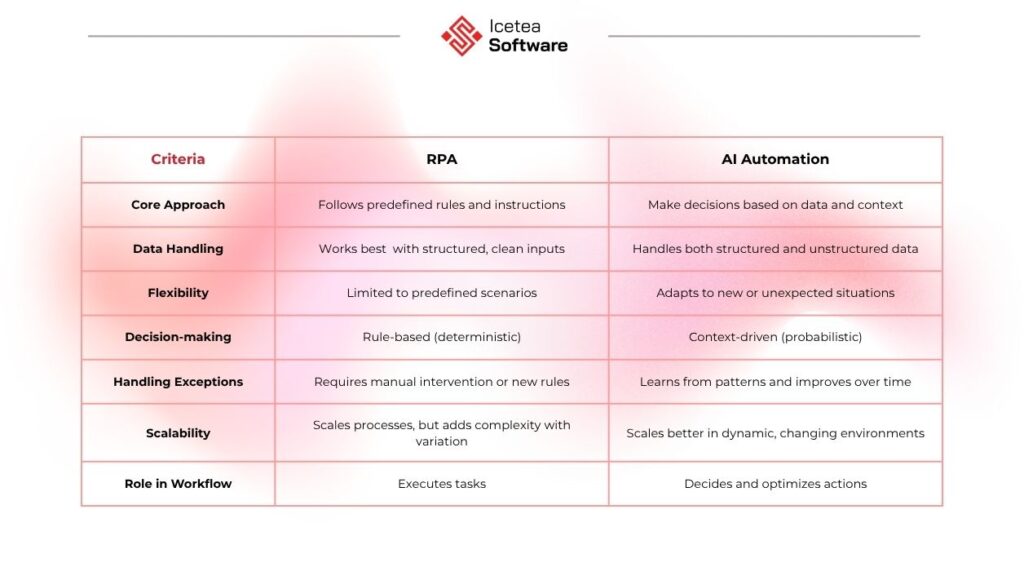
Robotic Process Automation (RPA): Structured Execution, Built on Predefined Logic
In many organizations, automation often starts with Robotic Process Automation (RPA). It’s a practical entry point, especially for tasks that follow clear, repeatable steps. RPA mimics human actions within digital systems. It follows predefined instructions, interacts with interfaces, and executes tasks exactly as configured. When the process is stable and well-defined, it can deliver immediate efficiency gains.
In practice, RPA works best when:
- Processes are stable and rarely change
- Inputs are structured and consistent
- Every step can be clearly mapped in advance
You’ll typically see RPA used for things like:
- Data entry and data transfer between systems
- Processing structured forms or transactions
- Running routine, rule-based workflows
AI Automation: Adaptive Decision-Making, Built on Context
AI automation operates with a different assumption: not everything can be predefined. Instead of following fixed instructions, it evaluates situations as they happen and determines what action makes the most sense in context.
You’ll typically see AI automation used when:
- Inputs are unstructured or incomplete
- Situations vary from one case to another
- Decisions require interpretation, not just rules
This allows it to:
- Understand intent rather than rely on exact matches
- Handle edge cases without constant rule updates
- Improve decisions over time as more data becomes available
How Businesses Should Implement AI Automation
Most companies struggle when they try to apply AI automation and realize that adding AI into a workflow doesn’t automatically make that workflow better. In many cases, it just makes the system harder to control. The difference between implementations that work and those that quietly fail usually comes down to one thing: where and how AI is introduced into the process.
Start Where the System is already Breaking
A common instinct is to apply AI automation to processes that are already running well, simply to “make them smarter”. That rarely creates meaningful impact. The real leverage sits in places where the system is under strain, where teams are already stepping in to fix gaps, handle exceptions, or make judgment calls that rules can’t cover.
You’ll usually find those points in:
- Customer-facing workflows with inconsistent inputs
- Processes that rely heavily on manual review
- Decision points where outcomes vary case by case
If AI automation doesn’t reduce friction in these areas, it’s likely being applied in the wrong place.
Don’t Automate Everything, Focus on the Decision Layer
One of the more expensive mistakes is trying to push AI across an entire workflow at once. In practice, most of the value sits in a much smaller surface area: the moments where a decision needs to be made.
Instead of redesigning everything, a more effective approach is to isolate those points and let AI automation handle:
- Interpreting inputs that are hard to standardize
- Choosing between multiple possible actions
- Prioritizing what should happen first
Everything else, execution, system updates, and task routing, can stay as it is. This is often the difference between a system that becomes more complex, and one that actually becomes easier to run.
Use the Data You Already Have, Don’t Wait for Perfect Conditions
There’s a tendency to delay implementation until data is “clean enough” or “complete enough”. That delay usually costs more than it saves.
Most AI automation systems don’t need perfect data to start. What they need is:
- Enough historical patterns to learn from
- Clear feedback on what outcomes are considered “good”
- A way to capture corrections when decisions are off
Waiting for ideal conditions often means missing the period where the system could already be learning.
Expect the First Version to be Imperfect, and Plan for It
One of the fastest ways to lose confidence in AI automation is to expect it to perform like a finished system from day one. And it won’t. Early outputs will be uneven, and some decisions will need correction. That’s not a failure of the system, it’s part of how it improves.
What matters more is whether:
- Decisions are being tracked
- Corrections are being captured
- The system is actually adjusting over time
Without that loop, even a well-designed system will stagnate.
Keep Human Judgment Where It Matters
Replacing human input entirely is rarely the goal and often creates more risk than value. What tends to work is a shift in role:
- Let AI automation handle volume and variation
- Let humans focus on exceptions, edge cases, and high-impact decisions
This reduces operational load without removing oversight. And just as importantly, it builds trust in the system, because teams can see whether it works, and where they still add value.
Measure What Changes, not just What Speeds Up
If the only metric is efficiency, most implementations will look successful at first. But that’s not where the long-term impact shows up. More meaningful signals tend to be:
- Fewer cases getting stuck or escalated
- Less need to update rules as conditions change
- Decisions becoming more consistent over time
These are harder to measure, but they reflect whether AI automation is improving how the system operates, not just how fast it runs.
Conclusion
If your system needs people to constantly “step in and fix things”, then it’s not really automated, it’s just partially outsourced to humans. That’s the gap AI automation starts to close, by taking over the parts that never quite worked without human judgment.
If that feeling sounds familiar, it’s worth taking a closer look. Reach out to Icetea Software to explore how AI automation can quietly remove that friction, without forcing you to rebuild everything from scratch.
————————————————————————
Icetea Software – Revolutionize Your Tech Journey!
Website: iceteasoftware.com
LinkedIn: linkedin.com/company/iceteasoftware
Facebook: facebook.com/IceteaSoftware