IT Outsourcing in Vietnam: A Practical Look For Enterprises
 YenDH
YenDH
IT Outsourcing is rarely a company’s first choice. Most teams prefer to build and scale in-house for as long as possible, even when hiring becomes increasingly difficult and legacy systems start to slow everything down. Over time, however, mounting delivery pressure, rising costs, and technical constraints force organizations to reconsider how their software is built and maintained.
At this stage, many businesses begin to explore alternatives to purely in-house development. Rather than being treated as a short-term workaround or a pure cost-saving measure, Vietnam is increasingly seen as a practical option for sustaining development velocity while addressing modernization and digital transformation needs. This blog offers a grounded look at IT outsourcing in Vietnam, focusing on how it is actually used by enterprises today and what decision-making should understand before moving forward.
IT Outsourcing in Vietnam: Scale Position, and Growth
The market for IT outsourcing in Vietnam has grown rapidly in both size and strategic importance. According to multiple industry forecasts, Vietnam’s IT outsourcing revenues reached approximately $698 million in 2024 and continue to grow at strong rates year-on-year.
Estimates vary slightly by source, but most show consistent upward momentum:
- Statista data projects the market to approach $880 million by 2028 with a compound annual growth rate (CAGR) above 15%.
- Other analyses forecast IT outsourcing in Vietnam revenues reaching $1.28 billion by 2028, supporting broader IT services growth beyond traditional development work. (Source: Vietnam Outsourcing Hub)
- Within the broader IT services ecosystem, the total Vietnam IT services market is projected to expand from around $2.37 billion in 2025 to nearly $4 billion by 2030.
This steady expansion reflects growing global demand for offshore and nearshore delivery models. Vietnam’s proportion of the total IT services market is significant, estimates put IT outsourcing is embedded in the country’s digital economy.
Vietnam has also secured strong placement on international indexes. For example, Vietnam often ranks among the top destinations globally for software outsourcing, recognized alongside long-established hubs such as India and Eastern Europe.
Key Business Applications of IT Outsourcing in Vietnam
Vietnamese outsourcing provides support for international enterprises across a wide range of technology needs. Here are the primary application areas where IT outsourcing in Vietnam delivers measurable value:
Software Development & Maintenance (Web, Mobile, Enterprise Systems)
Outsourcing core development work is the most established use case for IT outsourcing in Vietnam. Providers in Vietnam can cover full lifecycle services for:
- Web and mobile application development: From UI/UX design to native and cross-platform implementations
- Enterprise systems and internal platform builds: Supporting ERP integrations, CRM customizations, and business automation
- Ongoing maintenance and enhancement: Ensuring legacy and modern systems stay updated, secure, and aligned with evolving business goals
Vietnam offers deep developers talent, with estimates of 500,000+ software engineers and around 55,000 – 60,000 IT graduates entering the workforce annually, providing a scalable base for software development engagements.
Legacy System Modernization (Reducing Technical Debt)
Most mature enterprises now operate systems built over multiple technology generations, often incurring critical technical debt that slows development velocity and increases operational cost. Modernization, part of broader IT outsourcing in Vietnam engagements, typically focuses on:
- Refactoring monolithic, old-language codebases (e.g., legacy Java/.NET) into modular architectures
- Migrating aging backend systems to more efficient cloud or containerized platforms
- Replacing custom legacy middleware with standard, supported libraries and frameworks
Vietnam’s outsourcing providers offer structured modernization programs that blend project engineering with architecture design, quality assurance, and documentation, helping enterprises reduce accumulated technical debt and improve long-term agility.
Digital Transformation & Automation (Cloud, Data, AI)
Modern IT outsourcing in Vietnam engagements increasingly include digital transformation (DX) work, migrating business processes and applications to next-generation technologies:
- Cloud Enablement & Migration: Assistance with public cloud platforms (AWS, Azure, Google Cloud), private cloud setup, and hybrid solutions.
- Data Engineering & Analytics: Building analytics pipelines, dashboards, and data infrastructure supporting both BI and predictive insights
- AI & Automation: Integration of machine learning modules, chatbots, and robotic process automation (RPA) into client workflows
This DX expansion aligns with global enterprise trends emphasizing intelligent processes, data-driven decision-making, and scalable cloud architecture. Vietnam’s partner ecosystem, including providers proficient in these domains, positions the country as a reliable outsourcing base for transformative projects as well as traditional development tasks.
Vietnam’s Developer Landscape: A Growing and Maturing Talent Pool
A key driver behind the sustained growth of IT outsourcing in Vietnam is the country’s expanding and increasingly professional software engineering workforce. Vietnam currently has an estimated more than 550,000 developers and IT engineers, making it one of the largest technology talent pools in Southeast Asia. According to TopDev’s Vietnam IT Market Report 2023-2025, this number continues to grow as more students enter technology-related fields each year.
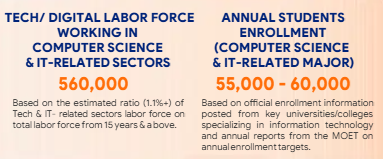
Vietnam’s education system plays an important role in this expansion. On average, over 55,000 IT graduates enter workforce annually, supplying a steady stream of junior and mid-level engineers to software companies and outsourcing providers. While many graduates require additional on-the-job training to align with specific enterprise requirements, this model has allowed outsourcing firms to scale teams quickly and cost-effectively, particularly for long-term development and maintenance projects.
In terms of skills, Vietnamese developers are widely recognized for their strong technical fundamentals, adaptability, and willingness to upskill. While advanced expertise in areas such as cloud-native architecture, DevOps, AI/ML, and cybersecurity is still developing, this has led many outsourcing providers to invest heavily in internal training programs, partnerships with global cloud vendors, and structured mentorship models. As a result, Vietnam’s outsourcing ecosystem has been steadily moving up the value chain, supporting not only application development but also modernization and digital transformation projects.
Read more: Vietnam’s Tech Landscape in 2025: A Deep Dive into the Promising Future of AI and Blockchain
Overall, Vietnam’s developer landscape is best described as fast-growing and maturing. The country offers enterprises access to a large, young, and increasingly skilled engineering workforce, supported by an outsourcing ecosystem that is actively investing in quality, training, and global delivery standards. These characteristics underpin Vietnam’s rising role in the IT outsourcing market and reinforce its reputation as a reliable destination for software development, modernization, and digital initiatives.
The Future of IT Outsourcing in Vietnam
The outlook for IT outsourcing in Vietnam remains positive, not because of abstract optimism, but due to measurable market growth, a clear shift toward higher-value services, and sustained international investment in the local tech ecosystem
Steady Market Growth with Verifiable Scale
Vietnam’s IT outsourcing market has shown consistent expansion over recent years. According to Statista, IT outsourcing revenue in Vietnam reached approximately US$698 million in 2024 and is projected to grow at a double-digit rate toward around US$880 million by 2028. These figures reflect stable demand from overseas clients rather than short-term outsourcing waves.
More importantly, outsourcing continues to account for a significant share of Vietnam’s broader IT services market, indicating that IT outsourcing in Vietnam is becoming structurally embedded in global delivery models, not treated as a tactical option. (Sources: Statista, VietnamPlus)
Moving Up the Value Chain, Not Just Competing on Cost
Cost efficiency remains relevant, but it is no longer the primary differentiator for IT outsourcing in Vietnam. Industry analyses from firms such as Mordor Intelligence show that outsourcing represents nearly 40% of Vietnam’s IT services revenue, alongside strong growth in cloud, data, and digital transformation services.
This suggests a gradual but clear shift: Vietnamese providers are increasingly involved in enterprise systems modernization, cloud migration, and data-driven platforms rather than limited-scope development work. For clients, this translates into longer engagements focused on system evolution and business outcomes.
Continued International Investment Signals Long-Term Confidence
Ongoing foreign investment further supports the long-term outlook. Global technology firms continue to establish and expand R&D and engineering operations in Vietnam. A notable example is SAP’s announced €150 million investment in a Vietnam-based R&D center, underscoring confidence in the country’s engineering talent and delivery maturity.
Such investments strengthen local capabilities and raise quality benchmarks across the outsourcing system, reinforcing Vietnam’s position as a sustainable, long-term partner rather than a short-term offshore alternative. (Source: Reuters)
How Enterprises Should Approach IT Outsourcing in Vietnam
Enterprises that succeed with IT outsourcing in Vietnam tend to approach it as a delivery design challenge rather than a simple sourcing decision. Instead of asking “which vendor should we choose?”, they focus on how outsourced teams fit into their existing engineering, product, and governance structures.
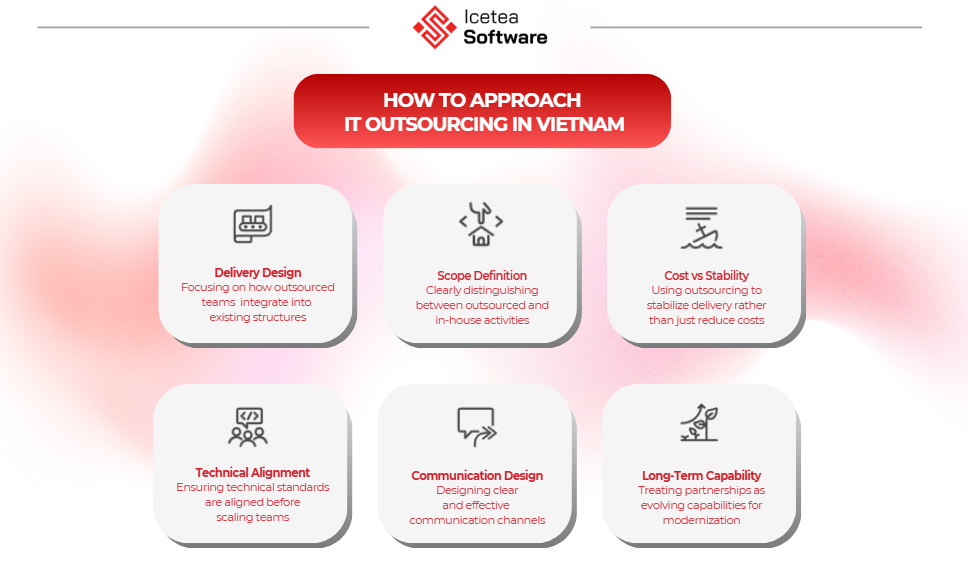
Be Explicit about What Should be Outsourced, and What Should Not
Not all work benefits equally from outsourcing. Enterprises should clearly distinguish between activities that are execution-heavy and repeatable, and those that are tightly coupled to business strategy or domain knowledge. Feature development, system maintenance, refactoring, and quality assurance are commonly outsourced to Vietnamese teams, while product vision, core architecture, and critical decision-making typically remain in-house.
Use Outsourcing to Stabilize Delivery, Not Just Reduce Cost
In practice, many enterprises turn to IT outsourcing in Vietnam to address fluctuating workloads, talent shortages, or delivery bottlenecks rather than purely to cut costs. Vietnamese teams are most effective when used to stabilize release velocity, reduce backlog accumulation, and enable parallel development streams. When outsourcing is framed as a way to protect delivery continuity, metrics naturally shift toward throughput, lead time, and defect trends instead of headcount or hourly rates
Align Technical Standards Before Scaling Teams
Technical misalignment is one of the most common sources of friction in offshore engagements. Before scaling, enterprises should align on coding standards, documentation expectations, testing practices, and tooling. Small pilot phases or limited-scope engagements are often used to validate alignment under real delivery conditions.
Design Communication for Clarity
Successful outsourcing does not require excessive meetings, but it does require intentional communication design. Clear ownership, well-defined handoffs, and shared visibility into progress are more effective than dense reporting layers. Vietnamese teams typically work well with structured workflows, clear priorities, and direct feedback loops. Lightweight routines, such as regular sprint check-ins and shared dashboards, helps maintain alignment without slowing delivery.
Manage the Relationship as a Long-Term Capability
Enterprises that extract the most value from IT outsourcing in Vietnam treat partnerships as evolving capabilities rather than transactional arrangements. Over time, Vietnamese teams develop system familiarity, domain understanding, and delivery maturity that cannot be replicated in short-term engagements. Investing in continuity, knowledge transfer, and mutual enables outsourcing relationships to support modernization and digital transformation efforts.
Conclusion
At some point, most teams reach a similar moment: there is simply more work than the the current team can realistically carry. Roadmaps keep growing, systems keep aging, and hiring no longer feels like a reliable lever. With an abundant engineering workforce and a maturing outsourcing ecosystem, Vietnam fits well into distributed development models that prioritize continuity and scalability over short-term fixes.
What matter most, however, is not the market itself but how companies engage with it. When Vietnamese teams are brought into the rhythm of everyday work, they grow alongside the systems they help deliver. Over time, outsourcing stops feeling external and starts to feel like an extension of the team itself. Seen this way, IT outsourcing in Vietnam is less about outsourcing work and more about sustaining progress in an increasingly distributed world.
Contact Icetea Software for collaboration!
————————————————————————
Icetea Software – Revolutionize Your Tech Journey!
Website: iceteasoftware.com
LinkedIn: linkedin.com/company/iceteasoftware
Facebook: Icetea Software